Monday, July 5, 2010

Finding People

When I got the cardboard box with what remained of my Great-Grandmother Blythe Stillwell's articles I was blessed that mounds of photos survived. I guess no one saw the value in these photos, but I did!
I didn't know all the people in those photos but I knew enough [and had my Mother to ask about others]. Thus started my genealogical journey finding out about the family I never knew.
And while I was looking for the people I knew I kept the photos of those I didn't.
This is one of the photos I put aside for later. I'm glad I did because the writing on the back of this postcard turned out to be a clue to the identity of one of the fellows pictured!

It was written to John Hinkley, Great Grandma Nonnie's adoptive father. On the back it says, " April 19, 1910. Can you pick Guy out? This is his force of men. He is the foreman of NP freight house. He has seven men under him. He first had this taken today.
Angie
He wanted me to send you one."

I had some pictures of William and Angie Hinkley at verious times of their lives. William was John Hinkley's brother. At one point I followed them through the US census. When John T. and Sallie Delaney Hinkley moved from Missouri to Nebraska, his brother William along with Angie Phillips Hinkley and their kids moved up to Butte, Montana! So I looked through further census for them in Montana, and what do you know? Guy is their son! I got that box out and looked through to see where I had read that name before and there was the postcard.

The clothing Guy's crew is wearing tells me that NP is a railroad.
A lookup on Google for NP railroad revealed a Wikipedia listing of original Montana railroads and their successors. NP was the Northern Pacific & Montana Railroad.

Keep those old photos with the people you don't know, because if you look long enough, you will!

Thursday, June 24, 2010

World War One Draft Cards


Did you know one of the best ways to find out about your early 20th Century male ancestor's physical characteristics? Find out if he has a WWI Draft registration card! Not only that but the information included on these cards could lead to other family members information.

This is the WWI Draft Card of my Great- great Uncle, Opie Hicks.
On the back of this card the examiner recorded information about eye color, hair color, complexion and build. On the front is nearest living relative, draftees birthplace, father's birthplace, place of employment.

From this card I learned that Opie had brown eyes and dark brown hair. He was 5 foot 8 inches tall. He was a farmer with a place near Farnam, Nebraska. He was born 10 Aug 1896 in Jonesborough, Tenn [where his father was also born] and that his father was W.R. Hicks.

You can confirm lots of theories about a male ancestor using these cards.
A good start for looking at these cards is

Online World War One Indexes & Records
http://www.militaryindexes.com/worldwarone/index.html

This and many other sites can be found by Googling World War One Draft Cards.
Lots of fun!


Saturday, June 19, 2010

Looking up Western Land Records in BLM GLO


When you go to the BLM GLO Records site the first thing you need to look for is the "Search Land Patents" link at the top of the page. Luckily, they designed the site so that the necessary links are always at the top of the pages [bless you folks!].
When clicking the link brings you to the search page, it's just a matter of picking the state where your ancestor lived, filling in their last name [and if you need to narrow the search, putting in their first name] and pushing the search button.
The reason you may only want to use a last name is because it allows you to read the list of land records under that name in case siblings or spouses may have homesteaded [yes, women did this too!].

Here we can see that I've entered L.J.'s last name only and Oklahoma for the state. That's because I knew that he and his family left Mississippi and settled in Kiowa County, OK. It was just a matter of finding out when.


The next image shows the Land Patent Details that resulted from the search. This gives the date and information about the land title. But look at the tabs at the top.
There's one for legal land description and one for Document Image. Legal land description will tell you exactly what section your ancestor got in their land grant or purchase. Document Image is a copy of the paperwork our ancestors received when they paid for the land [or met the requirements for homesteading].

There are also survey records and plat maps to be had. This may take a little more work to understand, but it is well worth it!

Go ahead, try it! I'll bet you'll be printing all kinds of paperwork if your family migrated west.

Looking up Land Records - BLM


This is one of the land records that relates to L.J. [Levi James] McNutt's purchase of land in Kiowa County, Oklahoma in 1908. Kiowa was one of the last Oklahoma counties to be opened for homesteading.
There's a wonderful tool provided by the BLM that lets you research your ancestors homesteading activities in the western states.
The BLM GLO Records.
http://www.glorecords.blm.gov/
This site only relates to land titles that where transferred from the Federal Government to individuals, and only relates to certain western states. "This site does not cover the thirteen colonies, their territories, and a few other states."

They are scanning and adding documents at a rapid rate so if your ancestor's land record, for the listed states, doesn't show up on the first search, come back again [often there will be a listing that says, scanning in progress].

The next couple of articles will explain how easy it is to use the Land Patents Search.

Wednesday, June 16, 2010

The River Running


So, while I was traveling back across Colorado I got to see, and record, the river. All the waterways around here are very high because of the record high temps that have caused quick snow melt, and now pouring rain! The rain pounded me for two-and a half days! It was hard to see over the hood of that little truck. Even though I enjoy the rain, I was glad when the sun got to come out.
I stopped to sleep in Frisco and when I woke I could hear the river outside the truck window. I decided to go investigate and found a nice little area down the embankment.
The sound is soooo cool!

Regency Rellies and Relocation


While I was off to the Front Range for the last four days trying to find a place to live, I realized that I already have some pictures of individuals in clothing from certain eras.
I make paperdolls for fun! And even better, I have historic clothing or international costumes, depending.
Here is Vinny in Regency clothing, about 1810 [copy-written, of course].
Can't you see him up on the back of a great black charger, cantering about the estate?

Tuesday, June 8, 2010

What our Ancestors Clothing Looked Like


Here's something I think will be new to family trees like Ancestry.com. In the space for media you can include photos and other media types related to your family member. Of course there is not likely to be a picture of family that lived before photography was invented [unless they had the money for portraiture]. So, in family tree software, if the only picture you have is a photo of the person's gravestone, that ends up being the primary photo. Yuck!
When I'm looking at an ancestor's info I don't want the only thing I see about them to be a gravestone.
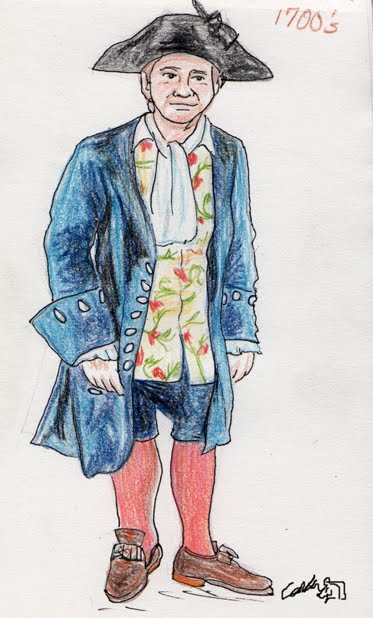
So I came up with the idea of researching the clothing they might have worn when they where living their lives and decided on drawing color pictures to put in the photo section of the media files!


Luckily there are many re-enactors and historians who have put information about historic costumes up on the web. Costumers Manifesto is one great site. Memorial Hall Museum Online, American Centuries...view from New England is another fun site for looking at our former dress and learning lots of other things about our New England ancestors. [This is where I got the pictures for my two drawings that appear here].


Sooo, I'll have to think about the furniture and utensils that they might have used and the places they lived. Did you know that the early new England settlers lived in homes that consisted of one room where everything went on? Not necessarily because they where poor [tho that was true for some at the early part of the English settlement] but because people then didn't have the same ideas of privacy that the American culture does today.
Interesting, eh?