Hi Everyone,
Sorry to be gone so long. Medical stuff came up and I went down!
Anyway, I am working on the Jeffery Family Book. So far it is in chapters concerning each family per generation [I have so much info it is hard to figure out how to arrange the stories and information -ah, such travails...] So I decided to go cronologicaly from the far back past to the current day. Id start with John and Mary Bishop Jeffery coming from Ireland. Then have a small blerb about each of their kids. Then write more about the kids I know of. Then go to the next generation and follow William and Mary Ferguson [and then Sarah Burney] Jeffery and their adventures. And do a small bit about their kids and so on until I get to the more recent generations.
I'm going to include pictures and illustrations. This should be pretty nice.
The other idea I had was to invite family members to read the info and add their two cents. There's others who know family stories or have letters and such that I don't have. So I thought it would be nice to get those bits of info in there if possible.
Then, there was finding out about the places where the Jeffery's lived at the time they lived there. Ohio, when it was first being settled was apparently a tree covered expanse. Old growth forest that blocked out the sun. People who visited upper Ohio in the early to mid 1800's said it was a dark gloomy region where the only place to see some sun was where the settlers had felled many of the trees and tried to clear the land. This is what the Jeffrey's had to do when they got to Congress, Wayne County, Ohio.
It's really fun to write about your ancestors and their lives and times. I don't want to just collect a bunch of info to put in my family tree. I want to know what happened to these people that were here before me. So collecting any stories and publishing them for the next generations is where I'm at!
Wednesday, September 14, 2011

Tuesday, April 19, 2011
Family History Writing Award!
The Southern California Genealogical Society has sent an anouncment to me. I have won top billing in their GENEii writers competition!
My narrative of Nellie Cowdrey's life during the Dust Bowl years will be published in "The Searcher." This is the Society's research and family history journal.
The SCGS is a well organized, very helpful organization. They have interesting information on their site for all family history researcher's, even those who do not live in Southern California.
http://www.scgsgenealogy.com/
Here is the listing of winners. Entries come from around the world.
My narrative of Nellie Cowdrey's life during the Dust Bowl years will be published in "The Searcher." This is the Society's research and family history journal.
The SCGS is a well organized, very helpful organization. They have interesting information on their site for all family history researcher's, even those who do not live in Southern California.
http://www.scgsgenealogy.com/
Here is the listing of winners. Entries come from around the world.
"Now with a drum roll and no further ado, here are the winners of the 2010 GENEii contest:
Category1:
> 1st Place - Carla Garner: Farm Wife
> 2nd Place - Janet Aird: Indian Princess
> 3rd Place - Ceferino Aheuro-Baca: Fur Trader
> Honorable Mention: Barbara Randall: Meet my Great Grandpa Arthur
> Finalists - Emily Cary: Perverse Roots; Lynda Barlow: Pistol Packin' Grandma
Category 2:
> 1st Place - Joyce Roberson: Reprise
> 2nd Place - Judith Cole: Jersey Shore
> 3rd Place - Marsha Worth: Math Teacher
> Honorable Mention - Carla Garner: Eva
> Finalist - Carla Garner: Community"
Sunday, January 23, 2011
The Family History Researchers Lament
The Family History Researchers Lament
by C.Garner

Those family books where in boxes, under tables, and in files with papers flopping about.
They sat on the kitchen table and covered all the counters, forcing me to eat out.
There's census copies in my car and little note books here and there.
There's even papers I have to move,
when I want to sit in a chair.
I've got files and folders and folios,
and I've gone and filled them too.
And there's still so many relatives out there,
What's a researcher to do?
Why, make friends at the local copy shop!
Get an office supply discount card.
And buy a big ol' bookshelf.
Because quitting's awful hard.
Carla
by C.Garner
Those family books where in boxes, under tables, and in files with papers flopping about.
They sat on the kitchen table and covered all the counters, forcing me to eat out.
There's census copies in my car and little note books here and there.
There's even papers I have to move,
when I want to sit in a chair.
I've got files and folders and folios,
and I've gone and filled them too.
And there's still so many relatives out there,
What's a researcher to do?
Why, make friends at the local copy shop!
Get an office supply discount card.
And buy a big ol' bookshelf.
Because quitting's awful hard.
Carla
Thursday, January 20, 2011
Family History and Cooking
Ever wonder what your ancestors ate?
I have been curious about my way-back-family's lifestyles since I first started searching for them.
Lately I've discovered the world of food historians and their research work into the world's repositories. They have been looking for recipes made by early American's, Native and Colonizers, people from other lands and cooking as recent as the 1970's!

For some of the early Colonists on the east coast of America, learning how to plant and prepare maize [corn] from the instructions of Native Peoples, was the only thing that kept them from starving. And did you know that Native folks in the 17th Century used controlled forest fires to prepare farm land the way we do today?
This was done "to clear their fields, drive game, and reduce insects" (Zanger, 2003). A side effect of this was to produce habitat favorable to berries. And they made something called "Strawberry Bread" with corn meal and sliced strawberries.
Use fine ground white corn meal, hull and dice strawberries into small pieces [don't puree]. Add one coup of cornmeal to one cup of small diced strawberries. Make a soft dough. Add more cornmeal to get a slightly firmer dough. Make into patties and place on wooden plank or soapstone griddle greased with bear fat [we can use a greased baking sheet in a 350 degree oven]. Cook 30 minutes, turning once around 15 minutes.
From the book, "The American History Cookbook" by Mark H. Zanger
This book is great! It covers our food traditions here in America from the First Nations folks in the 1200's all to way to the 1970's.
The Smithsonian has had an interesting foodways book out for a while now. The "Smithsonian Folklife Cookbook" Katherine S. and Thomas M. Kirlin 1991.
This tome follow American foodways from the early Native foods to New England, Mid-Atlantic, Southern, Upper Great Lakes, Great Plains, the West and Southwest and all the way out to The Islands.
The book explains the food history of a region and how it was affected by the influx of new immigrants over the centuries. So you can cook from recipes made by your Upper Great Lakes Cornish, Finn, German, African, Arab or Cambodian ancestors.
How about Muskrat with Corn or Spatzle or Qtayf or even Squeaky Cheeze! In here I found Swedish recipes I remember making when I was a kid. Maybe things your grandparents cooked are in here too!
The fun cookbook to look through was "Grandma's Wartime Kitchen" by Joanne Lamb Hayes. In this book are recipes that I remember watching my mother prepare and that I eventually started cooking for myself. May of these WWII standards are still made in the home today. Mac and Cheese, Baked Bean with Salt Pork and Molasses, and of course Fried Chicken. Chicken and game meat were easier to obtain during the rationing years. So was oleo because butter was being shipped overseas. So the home cook had to come up with new recipes to "make do" when something was rationed or there was a shortage. They came up with many ingenious ways to cope with a lack of sugar, good cuts of meat or other foods we consider essential today.

Do you still make tuna casserole? Canned fish was easier to get than cuts of beef back then. How about all those jello deserts? I still cringe when I think of that orange jello with the green beans in it. I think everyone put everything in jello, didn't they. Ever had Corned Beef Hash? That was a leftover from the war years. Sunday night folks prepared nice big meals if they had enough ration coupons. Then Monday the family knew they could expect a meal made from meat leftovers that had been "hashed" or chopped up fine and mixed with diced potatoes. We had to use everything because food was just hard to come by. With today's food prices, I bet people are going to have to start thinking of clever ways to use up leftovers from meals.
What kinds of foods did your ancestors eat? Do you have any family recipes that can be passed down to descendants? How about cooking stories to leave behind with your family history?
I have been curious about my way-back-family's lifestyles since I first started searching for them.
Lately I've discovered the world of food historians and their research work into the world's repositories. They have been looking for recipes made by early American's, Native and Colonizers, people from other lands and cooking as recent as the 1970's!

For some of the early Colonists on the east coast of America, learning how to plant and prepare maize [corn] from the instructions of Native Peoples, was the only thing that kept them from starving. And did you know that Native folks in the 17th Century used controlled forest fires to prepare farm land the way we do today?
This was done "to clear their fields, drive game, and reduce insects" (Zanger, 2003). A side effect of this was to produce habitat favorable to berries. And they made something called "Strawberry Bread" with corn meal and sliced strawberries.
Use fine ground white corn meal, hull and dice strawberries into small pieces [don't puree]. Add one coup of cornmeal to one cup of small diced strawberries. Make a soft dough. Add more cornmeal to get a slightly firmer dough. Make into patties and place on wooden plank or soapstone griddle greased with bear fat [we can use a greased baking sheet in a 350 degree oven]. Cook 30 minutes, turning once around 15 minutes.
From the book, "The American History Cookbook" by Mark H. Zanger
This book is great! It covers our food traditions here in America from the First Nations folks in the 1200's all to way to the 1970's.
The Smithsonian has had an interesting foodways book out for a while now. The "Smithsonian Folklife Cookbook" Katherine S. and Thomas M. Kirlin 1991.
This tome follow American foodways from the early Native foods to New England, Mid-Atlantic, Southern, Upper Great Lakes, Great Plains, the West and Southwest and all the way out to The Islands.
The book explains the food history of a region and how it was affected by the influx of new immigrants over the centuries. So you can cook from recipes made by your Upper Great Lakes Cornish, Finn, German, African, Arab or Cambodian ancestors.
How about Muskrat with Corn or Spatzle or Qtayf or even Squeaky Cheeze! In here I found Swedish recipes I remember making when I was a kid. Maybe things your grandparents cooked are in here too!
The fun cookbook to look through was "Grandma's Wartime Kitchen" by Joanne Lamb Hayes. In this book are recipes that I remember watching my mother prepare and that I eventually started cooking for myself. May of these WWII standards are still made in the home today. Mac and Cheese, Baked Bean with Salt Pork and Molasses, and of course Fried Chicken. Chicken and game meat were easier to obtain during the rationing years. So was oleo because butter was being shipped overseas. So the home cook had to come up with new recipes to "make do" when something was rationed or there was a shortage. They came up with many ingenious ways to cope with a lack of sugar, good cuts of meat or other foods we consider essential today.

Do you still make tuna casserole? Canned fish was easier to get than cuts of beef back then. How about all those jello deserts? I still cringe when I think of that orange jello with the green beans in it. I think everyone put everything in jello, didn't they. Ever had Corned Beef Hash? That was a leftover from the war years. Sunday night folks prepared nice big meals if they had enough ration coupons. Then Monday the family knew they could expect a meal made from meat leftovers that had been "hashed" or chopped up fine and mixed with diced potatoes. We had to use everything because food was just hard to come by. With today's food prices, I bet people are going to have to start thinking of clever ways to use up leftovers from meals.
What kinds of foods did your ancestors eat? Do you have any family recipes that can be passed down to descendants? How about cooking stories to leave behind with your family history?
Doing it a Little Different - Family History Research
I know, I haven't been here a while. Life has a way of interfering with our fun, eh? Finding jobs, finding places to live, getting the daily necessities. Kinda' like what our ancestors faced on a daily basis.

Still, even when vast amounts of things are being thrown my way, I still try and cram in a little research for a few minutes a day. Especially rewarding is finding out special info on how my way back family members lived and dealt with the problems of their daily lives.
And I've made a few interesting discoveries about the ancestors on my mother's side.
They weren't very obedient souls and didn't feel it necessary to to do everything the way everyone else does.
Kinda' like me! Not for me is the collecting of names and dates only. I am looking for information about the people and the way they lived. Why did they decide to do the things they did? What was it like to live when and where they did? Out there on the world wide web are repositories and blogs with photos and notes that put my people and their places in context. And it's easy to find. Just Google your ancestor's name and maybe a date but be sure to write "genealogy" in with your other search information. You can come up with all kinds of family history goodies!
Fortunately, many other family history researchers have posted their notes online. From my Google searches I've been able to find a book referring to my ancestors on Google Books or Internet Archive. Internet Archive is great because the books and other scanned objects are past their copyright and can be downloaded in their complete form.
Then there are the blogs and web pages where others have posted photos when they have traveled to historic places, like Cogswell's Grant. This is land in Essex, Mass “Granted to Mr. John Cogswell 300 acres of land at the further Chebokoe…” Chebokoe was an early name for the Essex River.

Here is a photo of the Essex River from Cogswell's Grant posted by Sue on her blog "Life Looms Large."
http://lifeloomslarge.blogspot.com/2009/06/cogswells-grant.html
I may not get to go out to visit Cogswell's Grant for a while, so it's nice to be able to see pics and info about the places my ancestors lived.
Then there's the things they did, like being fined for falling asleep in church! My many times great grandfather Samuel Bennett "...were presented in court for being 'Common sleepers in church' and fined each two shillings and a sixpence." This happened in 1644 in Essex Mass and you can read more about Samuel Bennett and family on the Phillip Roach Heritage page on Family Tree Maker's Home Pages.
http://familytreemaker.genealogy.com/users/r/o/a/Susan-B-Roach/BOOK-0001/0002-0017.html
Phillip Roach did a great job with his family tree notes and was kind enough to post them for the rest of us to read. All I did to find this was write "Samuel Bennett Rhode Island" in Google search and I learned something interesting about an ancestor.
Here we have "The Bennett Family: 1628 - 1910" from the Internet Archive. This is a down loadable book. The nice thing about this is the family genealogist can download and read later or print out the pertinent pages they might find.
http://www.archive.org/details/bennettfamily16200benn
Go to Internet Archive, and in their search window select "American Texts" and write in the family name you are looking for.
And then there was Robert Wheaton...
“Robert was a very strong Baptist, and it was because he would not or did not agree with the Puritan way that he was considered a rebel. He had landed in Salem, where ‘his independence of thought and speech made him enemies who finally drove him from the town as a ‘pestilential fellow.’”
Robert Wheaton moved on until he eventually became one of the founders of Rehoboth, Bristol County, Mass.
These and many more goodies are listed in the pages of "Descendants of Robert WHEATON"
http://www.wheatonjk.co.uk/Robert_and_Alice_BOWEN.htm
I've used this search method to fill out my family history and learn more about my ancestors then I thought possible at the beginning of my family search twenty-five years ago.
So, I know that doing things differently than the normal route can lead to new thinking and new discoveries. So try a new search today!Friday, October 15, 2010
Eva Jeffery homesteads in South Dakota!
Made a discovery while I was searching for Dad's Jeffery relatives [we're looking in Ohio, Wisconsin and Nebraska]. His great-great-grandfather John Jeffery had a couple of half sisters that decided to homestead in south Dakota late in the 1800's!
Turns out that Eva's sister Mary Ann married Francis DeVoe and that may have been the reason Eva went up to Dakota Territory. Because her sister and brother-in-law went. Turns out that Francis DeVoe's brother George homesteaded land right next door to Francis and Mary Ann. Eva was just a little bit aways in the same section.
So, how did I find all this out?
Well, a great aunt left her genealogy notes from when they where searching out family facts in the 1960's. And one of these notes mentioned that the Jeffery girls came out to Nebraska and then went to South Dakota to homestead near Yankton. That was all it said though!
Here these two women went off and did something women wern't supposed to be capable of doing. Survived on a claim up in the Dakota Territory. That would mean living ruder than folks down in the States. The weather up there could be harsh. Droughts, freezing winters, blizzards - all kinds of fun stuff! And Eva went up and stayed on her own claim, no man around [she never did marry].
So, it was time to hit the Dakota Territory census and the BLM GLO records.
http://www.glorecords.blm.gov
the BLM patent search has a new setup now, with a few more fun tools. And even though Eva Jeffery's homestead patent hasn't been indexed yet [therefore no image of the paperwork available yet], it does have this neat interface to look on a map and find just where our ancesters homestead was!
 So, there's all the BLM info for Eva's homestead and a little map of the section and where it sits in today's world. From this info a person can write to the National Archives to get the land patent info or to the local historical / genealogical society to find out more about and ancestor that made such a brave move [I chose the latter - I hope to get a little more info about Eva's life on the homestead, and if I'm lucky, they might be able to lead me to some photos!]
 From the 1880 Yankton Dakota Territory census, it looks like Eva [called Rachel in some census] supported herself as a school teacher and lived with her sister's family until she could get her own claim [which is about right because the BLM records say she filed on her claim in October of 1882].
So there's more to look for.
In this same census we can see that their mother, Sarah Jeffery was living with the family also. It seems from the records that Eva Jeffery and her sister's family stayed in South Dakota for about twenty years and then moved to Deer Park, Washington. Well, what was in Washington that brought on such a change in living places?
Sarah Burney Jeffery is buried next to her husband William Jeffery in the Rose Hill Cemetery in Waverly, Lancaster County, Neb. I surmise that she died in Yankton and that not long after, her girls moved to Washington State.
Now to find out what was out west!
Turns out that Eva's sister Mary Ann married Francis DeVoe and that may have been the reason Eva went up to Dakota Territory. Because her sister and brother-in-law went. Turns out that Francis DeVoe's brother George homesteaded land right next door to Francis and Mary Ann. Eva was just a little bit aways in the same section.
So, how did I find all this out?
Well, a great aunt left her genealogy notes from when they where searching out family facts in the 1960's. And one of these notes mentioned that the Jeffery girls came out to Nebraska and then went to South Dakota to homestead near Yankton. That was all it said though!
Here these two women went off and did something women wern't supposed to be capable of doing. Survived on a claim up in the Dakota Territory. That would mean living ruder than folks down in the States. The weather up there could be harsh. Droughts, freezing winters, blizzards - all kinds of fun stuff! And Eva went up and stayed on her own claim, no man around [she never did marry].
So, it was time to hit the Dakota Territory census and the BLM GLO records.
http://www.glorecords.blm.gov
the BLM patent search has a new setup now, with a few more fun tools. And even though Eva Jeffery's homestead patent hasn't been indexed yet [therefore no image of the paperwork available yet], it does have this neat interface to look on a map and find just where our ancesters homestead was!


So there's more to look for.
In this same census we can see that their mother, Sarah Jeffery was living with the family also. It seems from the records that Eva Jeffery and her sister's family stayed in South Dakota for about twenty years and then moved to Deer Park, Washington. Well, what was in Washington that brought on such a change in living places?
Sarah Burney Jeffery is buried next to her husband William Jeffery in the Rose Hill Cemetery in Waverly, Lancaster County, Neb. I surmise that she died in Yankton and that not long after, her girls moved to Washington State.
Now to find out what was out west!
Monday, September 13, 2010
The Family History Researchers Lament
The Family History Researchers Lament
by C.Garner
Those family books where in boxes, under tables, and in files with papers flopping about.
They sat on the kitchen table and covered all the counters, forcing me to eat out.
There's census copies in my car and little note books here and there.
There's even papers I have to move,
when I want to sit in a chair.
I've got files and folders and folios,
and I've gone and filled them too.
And there's still so many relatives out there,
What's a researcher to do?
Why, make friends at the local copy shop!
Get an office supply discount card.
And buy a big ol' bookshelf.
Because quitting's awful hard.
Carla
by C.Garner
Those family books where in boxes, under tables, and in files with papers flopping about.
They sat on the kitchen table and covered all the counters, forcing me to eat out.
There's census copies in my car and little note books here and there.
There's even papers I have to move,
when I want to sit in a chair.
I've got files and folders and folios,
and I've gone and filled them too.
And there's still so many relatives out there,
What's a researcher to do?
Why, make friends at the local copy shop!
Get an office supply discount card.
And buy a big ol' bookshelf.
Because quitting's awful hard.
Carla
Tell us why this is so important
There's the little things we miss if we don't pay attention. What did Grandma say about that piece of silverware or the old clock on the mantle. What was Dad telling you about the postcard that Grandpa sent back to Sweden. If we really listened to those stories we've heard in family gatherings or at the dinner table, what clues would we find?
How about letters saved and sitting in a box somewhere? Are there clues to a family member's life adventures?

I find and record these genealogical facts and dates and locations so I can tell the stories of those who have gone before. Ordinary lives that have become extraordinary - and important. How did Great-grandma survive the Depression. How did Great-greatgrandpa make that trip across the prairie? How did great Aunt survive the relocation and boarding school life she was forced into? Does Uncle remember what he thought when Rosa Parks wouldn't sit in the back of the bus? What did Dad do to get past the time in the military? How did Mom help you through the effects of The Big One?
Did someone tell you a story? Did someone show you a tool or an article and describe what it was for and who used it? Do you remember? Have you written it down?
It's all part of a larger story. One that you will want to leave for your grandkids or greatgrandchildren, or even the children of others, who will very soon be running this world. What kind of values and ideas do you want to leave for them?
How will they know unless you record it?
Write it down. Record it. Take a picture.
Tell us why the things Grandma did back in the Old Days is important to us today.
How about letters saved and sitting in a box somewhere? Are there clues to a family member's life adventures?

I find and record these genealogical facts and dates and locations so I can tell the stories of those who have gone before. Ordinary lives that have become extraordinary - and important. How did Great-grandma survive the Depression. How did Great-greatgrandpa make that trip across the prairie? How did great Aunt survive the relocation and boarding school life she was forced into? Does Uncle remember what he thought when Rosa Parks wouldn't sit in the back of the bus? What did Dad do to get past the time in the military? How did Mom help you through the effects of The Big One?
Did someone tell you a story? Did someone show you a tool or an article and describe what it was for and who used it? Do you remember? Have you written it down?
It's all part of a larger story. One that you will want to leave for your grandkids or greatgrandchildren, or even the children of others, who will very soon be running this world. What kind of values and ideas do you want to leave for them?
How will they know unless you record it?
Write it down. Record it. Take a picture.
Tell us why the things Grandma did back in the Old Days is important to us today.
Tuesday, August 31, 2010
The McNutt Mystery
A new little part to the Levi James McNutt mystery came to me the other day.
A person named Gardner is a Find A Grave volunteer over in Mississippi. She found Sarah Frances Hopkins grave stone!
Sarah Frances Hopkins is the daughter if Elisha and Elizabeth Smithwick Hopkins. She is also the only Sarah Hopkins that was the daughter of Elisha and Elizabeth Hopkins, the Grandparents of Levi James McNutt. This makes it possible that this is the grave of LJ McNutt's mother.

This graveyard is in Guntown, Lee County, Mississippi. It's an old graveyard and apparently abandoned even though it is right in town. An interesting thing was the good condition of the gravestone. I said that someone must have put a new stone there since the one placed there in 1874 would have been well worn by now. I was hoping there might be living relatives still in the area. Gardner wrote back and mentioned that the gravestone was an example of pottery markers. Apparently these where found in northeastern Mississippi and northwestern Alabama. Pottery markers are glazed and weather well compared to marble markers.
http://hillcountryhogsblog.blogspot.com/2010/03/loyd-style-stoneware-or-pottery-grave.html
I will be writing to Guntown city hall to find out if they know anything about the folks buried in the field across from them...
A person named Gardner is a Find A Grave volunteer over in Mississippi. She found Sarah Frances Hopkins grave stone!
Sarah Frances Hopkins is the daughter if Elisha and Elizabeth Smithwick Hopkins. She is also the only Sarah Hopkins that was the daughter of Elisha and Elizabeth Hopkins, the Grandparents of Levi James McNutt. This makes it possible that this is the grave of LJ McNutt's mother.

This graveyard is in Guntown, Lee County, Mississippi. It's an old graveyard and apparently abandoned even though it is right in town. An interesting thing was the good condition of the gravestone. I said that someone must have put a new stone there since the one placed there in 1874 would have been well worn by now. I was hoping there might be living relatives still in the area. Gardner wrote back and mentioned that the gravestone was an example of pottery markers. Apparently these where found in northeastern Mississippi and northwestern Alabama. Pottery markers are glazed and weather well compared to marble markers.
http://hillcountryhogsblog.blogspot.com/2010/03/loyd-style-stoneware-or-pottery-grave.html
I will be writing to Guntown city hall to find out if they know anything about the folks buried in the field across from them...
Monday, August 30, 2010
Did the Snare family go to Nebraska?
The whole herd move from Illinois to Nebraska!
Mary Ann Snare [b:1832 in Licking County, Ohio] married William Maxwell Reed [b: 1827 in Newark, Licking County, Ohio] over in Licking County, Ohio. They moved over to Knox County Illinois about 1855 where children, Mahala, Nora, William, Otis, Effie and Hulda where born.

Then as a family, the Reeds moved to Nebraska about the same time as the Jeffery's, whom they had married into, came from Grant County, Wisconsin. I was wondering if the Snare's moved to Nebraska along with the other families. It looks like John Jeffery even took his father-in-law Jacob Hall to settle in Nebraska territory. So there must have been a number of ox drawn wagons going west to Lancaster County, Nebraska a little before 1867.
Daniel and Mary Ann "Polly" Crowell Snare moved with the family from Licking County, Ohio to Knox County, Illinois about 1855. Daniel and Mary Ann didn't go to Nebraska though. They both died in Harmon, Knox County, Ill.
So the next question is, did any of the Snare kids go to Nebraska [besides Mary Ann].
Hummm. No, Melissa Snare got married to William C. McElrea and they lived out their lives in Harmon, Knox County, Ill.
Sidney Whipple Snare ended up in Grand Junction, Mesa County, Colorado. He married Sarah Ellen Babbitt.
Sarah Ellen Snare married Martin Milam and ended up in San Bernardino, San Bernardino County, California.
So what happened to Laura, Lyman and Reevis?
Did they stay in Ohio?
Inquiring minds want to know.
Time to do some census review and a little looking in the Licking County OH and Lancaster County, Neb archives on
www.usgenweb.com
Guess I'd better go find out!
Mary Ann Snare [b:1832 in Licking County, Ohio] married William Maxwell Reed [b: 1827 in Newark, Licking County, Ohio] over in Licking County, Ohio. They moved over to Knox County Illinois about 1855 where children, Mahala, Nora, William, Otis, Effie and Hulda where born.

Then as a family, the Reeds moved to Nebraska about the same time as the Jeffery's, whom they had married into, came from Grant County, Wisconsin. I was wondering if the Snare's moved to Nebraska along with the other families. It looks like John Jeffery even took his father-in-law Jacob Hall to settle in Nebraska territory. So there must have been a number of ox drawn wagons going west to Lancaster County, Nebraska a little before 1867.
Daniel and Mary Ann "Polly" Crowell Snare moved with the family from Licking County, Ohio to Knox County, Illinois about 1855. Daniel and Mary Ann didn't go to Nebraska though. They both died in Harmon, Knox County, Ill.
So the next question is, did any of the Snare kids go to Nebraska [besides Mary Ann].
Hummm. No, Melissa Snare got married to William C. McElrea and they lived out their lives in Harmon, Knox County, Ill.
Sidney Whipple Snare ended up in Grand Junction, Mesa County, Colorado. He married Sarah Ellen Babbitt.
Sarah Ellen Snare married Martin Milam and ended up in San Bernardino, San Bernardino County, California.
So what happened to Laura, Lyman and Reevis?
Did they stay in Ohio?
Inquiring minds want to know.
Time to do some census review and a little looking in the Licking County OH and Lancaster County, Neb archives on
www.usgenweb.com
Guess I'd better go find out!
Tuesday, August 10, 2010
Genealogy fun while unpacking, Brown and Palmer

I couldn't help it. Even while I am still unpacking and trying to get the house in order I had to look around on the internet. In an Ancestry.com newsletter someone mentioned state census.' I have had a good time looking at the state census related to the places our folks have lived because you never know what kind of information you will find. Some are as plain as the early Nebraska state census, where people where named and the places they lived where listed, and that was it. But the early Iowa census was another matter. I found my many time great grandparents Fred and Susan T. Knowles Brown with all their kids. Not only that, but the 1885 Iowa State Census had as much info as the Federal Census. Profession, where born, what county if they where born in Iowa, whether their parents where native or immigrant and if they could vote [males only]. It also showed that males where subject to military duty. And while perusing this document I happened to glance down the page and see Claude and Mary Palmer where living nearby. Mary is the daughter of Susan T and Fred Brown. Nice bit of extra information there, because I didn't know that Claude and Mary had a daughter named Carrie.
Moving genealogy stuff
Ok, Moving isn't the greatest fun I've ever had. But this time it went a little better. I had family papers in files if they weren't in the books yet. There's plastic hanging file boxes that a few hanging files slip right into. They're nice because you can use the carry handle to tote them right off to the latest place of research or pack into the right size box just as they are.
This time, photos where in the proper photobook or in a central repository [a large plastic file] so they could be safely transported. I even got everything into the boxes in some sort of order so that when I got the chance to work with the information over here at the new place, I would know what it was! [Where not talking the most tidy mind here - I'm the "pile it, don't file it" kind].
Now if I could only find my camera and memory sticks and such...
This time, photos where in the proper photobook or in a central repository [a large plastic file] so they could be safely transported. I even got everything into the boxes in some sort of order so that when I got the chance to work with the information over here at the new place, I would know what it was! [Where not talking the most tidy mind here - I'm the "pile it, don't file it" kind].
Now if I could only find my camera and memory sticks and such...
Thursday, July 22, 2010
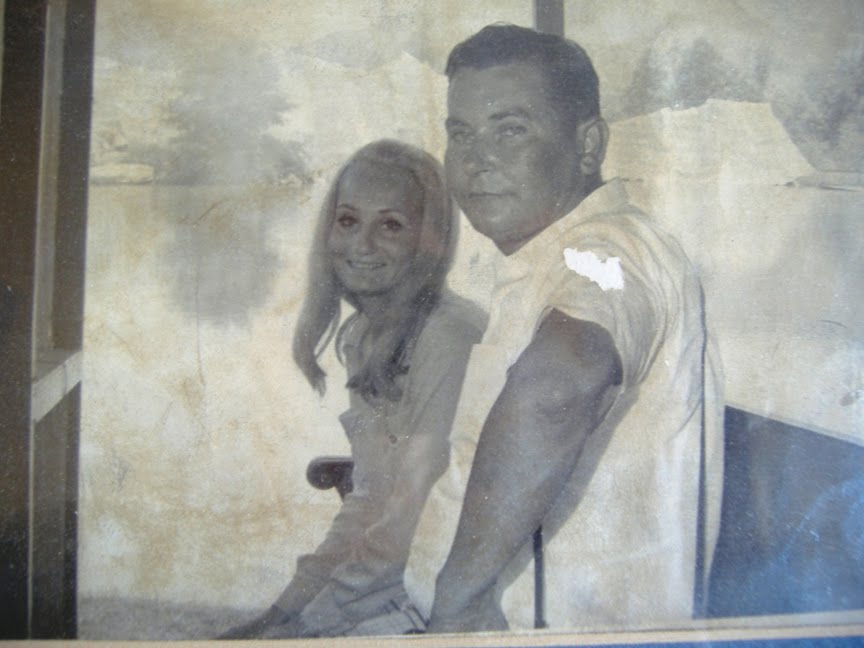
Isn't it neet to come upon some surprises sometimes?
Here we have a picture of my Aunt Kathy and her father Arthur Lovell Martin. She has this photo in a frame in her home office. I asked her about it in an offhand way. She surprised me with a story about the photo and several stories related to it.
Experienced genealogical researchers say to talk to living family members first and see what kind of information and artifacts they may have in their possession.
My Aunt was always in my life. I took her for granted. I never thought to ask her any questions about family because she didn't offer any information. And here she turned out to have a treasure trove of memories and on top of that, a few shoe boxes of wonderful photos!
When I sat and looked at these photos with her I got to ask more questions which lead to more memories, and even more places to search.
Remember, never take anyone in your family for granted...
Monday, July 5, 2010
Finding People
 When I got the cardboard box with what remained of my Great-Grandmother Blythe Stillwell's articles I was blessed that mounds of photos survived. I guess no one saw the value in these photos, but I did!
I didn't know all the people in those photos but I knew enough [and had my Mother to ask about others]. Thus started my genealogical journey finding out about the family I never knew.
And while I was looking for the people I knew I kept the photos of those I didn't.
This is one of the photos I put aside for later. I'm glad I did because the writing on the back of this postcard turned out to be a clue to the identity of one of the fellows pictured!
It was written to John Hinkley, Great Grandma Nonnie's adoptive father. On the back it says, " April 19, 1910. Can you pick Guy out? This is his force of men. He is the foreman of NP freight house. He has seven men under him. He first had this taken today.
Angie
He wanted me to send you one."
I had some pictures of William and Angie Hinkley at verious times of their lives. William was John Hinkley's brother. At one point I followed them through the US census. When John T. and Sallie Delaney Hinkley moved from Missouri to Nebraska, his brother William along with Angie Phillips Hinkley and their kids moved up to Butte, Montana! So I looked through further census for them in Montana, and what do you know? Guy is their son! I got that box out and looked through to see where I had read that name before and there was the postcard.
The clothing Guy's crew is wearing tells me that NP is a railroad.
A lookup on Google for NP railroad revealed a Wikipedia listing of original Montana railroads and their successors. NP was the Northern Pacific & Montana Railroad.
Keep those old photos with the people you don't know, because if you look long enough, you will!
Thursday, June 24, 2010
World War One Draft Cards

Did you know one of the best ways to find out about your early 20th Century male ancestor's physical characteristics? Find out if he has a WWI Draft registration card! Not only that but the information included on these cards could lead to other family members information.
This is the WWI Draft Card of my Great- great Uncle, Opie Hicks.
On the back of this card the examiner recorded information about eye color, hair color, complexion and build. On the front is nearest living relative, draftees birthplace, father's birthplace, place of employment.
From this card I learned that Opie had brown eyes and dark brown hair. He was 5 foot 8 inches tall. He was a farmer with a place near Farnam, Nebraska. He was born 10 Aug 1896 in Jonesborough, Tenn [where his father was also born] and that his father was W.R. Hicks.
You can confirm lots of theories about a male ancestor using these cards.
A good start for looking at these cards is
Online World War One Indexes & Records
http://www.militaryindexes.com/worldwarone/index.html
This and many other sites can be found by Googling World War One Draft Cards.
Lots of fun!
Saturday, June 19, 2010
Looking up Western Land Records in BLM GLO


When you go to the BLM GLO Records site the first thing you need to look for is the "Search Land Patents" link at the top of the page. Luckily, they designed the site so that the necessary links are always at the top of the pages [bless you folks!].
When clicking the link brings you to the search page, it's just a matter of picking the state where your ancestor lived, filling in their last name [and if you need to narrow the search, putting in their first name] and pushing the search button.
The reason you may only want to use a last name is because it allows you to read the list of land records under that name in case siblings or spouses may have homesteaded [yes, women did this too!].
Here we can see that I've entered L.J.'s last name only and Oklahoma for the state. That's because I knew that he and his family left Mississippi and settled in Kiowa County, OK. It was just a matter of finding out when.
The next image shows the Land Patent Details that resulted from the search. This gives the date and information about the land title. But look at the tabs at the top.
There's one for legal land description and one for Document Image. Legal land description will tell you exactly what section your ancestor got in their land grant or purchase. Document Image is a copy of the paperwork our ancestors received when they paid for the land [or met the requirements for homesteading].
There are also survey records and plat maps to be had. This may take a little more work to understand, but it is well worth it!
Go ahead, try it! I'll bet you'll be printing all kinds of paperwork if your family migrated west.
Looking up Land Records - BLM


This is one of the land records that relates to L.J. [Levi James] McNutt's purchase of land in Kiowa County, Oklahoma in 1908. Kiowa was one of the last Oklahoma counties to be opened for homesteading.
There's a wonderful tool provided by the BLM that lets you research your ancestors homesteading activities in the western states.
The BLM GLO Records.
http://www.glorecords.blm.gov/
This site only relates to land titles that where transferred from the Federal Government to individuals, and only relates to certain western states. "This site does not cover the thirteen colonies, their territories, and a few other states."
They are scanning and adding documents at a rapid rate so if your ancestor's land record, for the listed states, doesn't show up on the first search, come back again [often there will be a listing that says, scanning in progress].
The next couple of articles will explain how easy it is to use the Land Patents Search.
Wednesday, June 16, 2010
The River Running
So, while I was traveling back across Colorado I got to see, and record, the river. All the waterways around here are very high because of the record high temps that have caused quick snow melt, and now pouring rain! The rain pounded me for two-and a half days! It was hard to see over the hood of that little truck. Even though I enjoy the rain, I was glad when the sun got to come out.
I stopped to sleep in Frisco and when I woke I could hear the river outside the truck window. I decided to go investigate and found a nice little area down the embankment.
The sound is soooo cool!
Regency Rellies and Relocation

While I was off to the Front Range for the last four days trying to find a place to live, I realized that I already have some pictures of individuals in clothing from certain eras.
I make paperdolls for fun! And even better, I have historic clothing or international costumes, depending.
Here is Vinny in Regency clothing, about 1810 [copy-written, of course].
Can't you see him up on the back of a great black charger, cantering about the estate?
Tuesday, June 8, 2010
What our Ancestors Clothing Looked Like

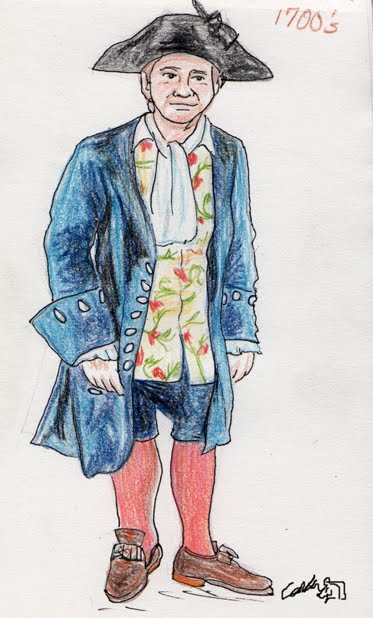
Here's something I think will be new to family trees like Ancestry.com. In the space for media you can include photos and other media types related to your family member. Of course there is not likely to be a picture of family that lived before photography was invented [unless they had the money for portraiture]. So, in family tree software, if the only picture you have is a photo of the person's gravestone, that ends up being the primary photo. Yuck!
When I'm looking at an ancestor's info I don't want the only thing I see about them to be a gravestone.
So I came up with the idea of researching the clothing they might have worn when they where living their lives and decided on drawing color pictures to put in the photo section of the media files!
Luckily there are many re-enactors and historians who have put information about historic costumes up on the web. Costumers Manifesto is one great site. Memorial Hall Museum Online, American Centuries...view from New England is another fun site for looking at our former dress and learning lots of other things about our New England ancestors. [This is where I got the pictures for my two drawings that appear here].
Sooo, I'll have to think about the furniture and utensils that they might have used and the places they lived. Did you know that the early new England settlers lived in homes that consisted of one room where everything went on? Not necessarily because they where poor [tho that was true for some at the early part of the English settlement] but because people then didn't have the same ideas of privacy that the American culture does today.
Interesting, eh?
Subscribe to:
Posts (Atom)